A bench grinder for knife sharpening requires balancing speed for heavy metal removal against control for fine edges. Some models use water to keep blades cool, while others rely on low-speed motors to prevent heat damage. Your selection depends on your specific tools and experience level.
Best overall: Tormek T-8 Original, which provides a complete, water-cooled system designed to sharpen all your edge tools with precision and safety, making it the most versatile choice for serious tool maintenance.
Best for beginners: Scheppach Tiger 2500, a system that includes a universal grinding jig and angle gauge to help those without prior experience achieve professional, razor-sharp results on their workshop tools and blades.
Best for speed: DEWALT DW758 Bench Grinder, which features a powerful 3/4 HP motor running at 3,600 RPM, ideal for users who need industrial-grade power for rapid material removal on large items.
The rest of this guide is for anyone looking to upgrade their workshop setup with a reliable sharpening solution.
How We Picked
We compared 48 different Amazon listings to find the best options for various sharpening needs. To earn a spot, a product had to provide clear, essential specifications including motor power, rotation speed, and included accessories like grinding wheels or jigs. We focused on machines that clearly state their intended use, such as water-cooled systems for heat-sensitive steel or high-speed grinders for general shaping. Products that lacked clear technical data or failed to outline their key features were removed from consideration.
All 10 products side by side — scroll sideways to see every column.
| Top Pick | Best for Woodworkers | Also Great | Best for Belt Sanding | Best for CBN Wheels | Best for Large Blades | Best for Metal Removal | Best for Small Workshops | Best for Simple Tasks | ||
| Preview |  |  |  | ](https://m.media-amazon.com/images/I/71HweomVeHL._AC_SL500_.jpg) |  |  |  |  | 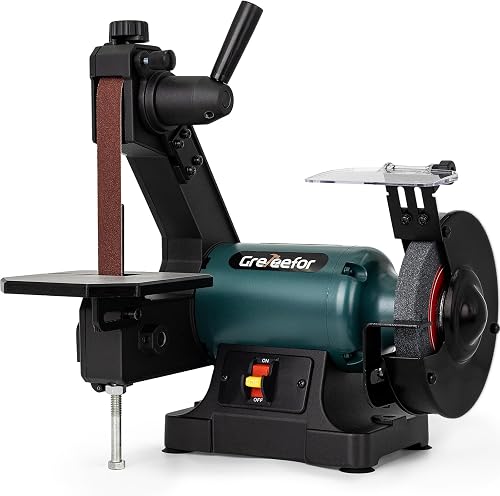 |  |
|---|---|---|---|---|---|---|---|---|---|---|
| Product | Tormek T-8 Original | RIKON 80-805 Professional | 10 Inch Wet System | BUCKTOOL 1×30 Belt Sander | BUCKTOOL 8 Low Speed | 6-Inch Variable Speed Grinder | Scheppach Tiger 2500 | DEWALT DW758 Bench Grinder | 6-Inch Grinder Belt Combo | WEN BG4260 Bench Grinder |
| Brand | Tormek | RIKON Power Tools | KFMK | Bucktool | Bucktool | Greteefor | Scheppach | DEWALT | Greteefor | WEN |
| Best for | Best Overall | Best for Woodworkers | Also Great | Best for Belt Sanding | Best for CBN Wheels | — | Best for Large Blades | Best for Metal Removal | Best for Small Workshops | Best for Simple Tasks |
| The listing says | Sharpens all edge tools | 1/2 HP motor runs at 1,750 RPM 8" x 1" 60- and 120-grit wheels | 1.0A – 1.2A motor, 90~160 RPM 10-inch aluminum oxide wet wheel | 1 x 30 belt sander, 1790 RPM 2.3A induction motor | 4.8A 1750RPM 3/4Hp motor 8" x 1" 80 grit and 8" x 1-1/2" 120 grit wheels | 2.5A brushless induction motor 1725–3450 RPM with 36-grit and 60-grit wheels | 200 W induction motor 250 mm 220 grit corundum stone | 3/4 HP induction motor Cast iron base and motor housing | 2.3A motor, 3600 RPM grinder, 3400 FPM belt 1" x 30" belt sander with three belts | 2.1-amp motor, 3450 RPM 6-by-3/4-inch wheels |
| More information | Price on Amazon | Price on Amazon | Price on Amazon | Price on Amazon | Price on Amazon | Price on Amazon | Price on Amazon | Price on Amazon | Price on Amazon | Price on Amazon |
1. Tormek T-8 Original
Best for: Users needing a versatile, water-cooled system for all edge tools.
This system handles a wide range of edge tools using a water-cooled process. This approach protects the temper of your steel by preventing overheating during the sharpening process. It’s a comprehensive unit that aims to cover every sharpening need in your workshop.
The Tormek T-8 Original suits those who want a dedicated, precise sharpening station. If you need to perform heavy-duty metal grinding or rapid shaping, look elsewhere. Its design prioritizes edge refinement over high-speed material removal.
If your primary goal is restoring a dull edge to a razor-sharp finish, this machine is the correct tool. If you’re trying to grind away large amounts of metal to change a blade’s profile, you’ll find the process frustratingly slow.
Pros
- Sharpen all your edge tools.
- Water-cooled sharpening system.
- Includes English handbook.
Cons
- Not for rapid material removal.
2. RIKON 80-805 Professional 8-Inch Low Speed Bench Grinder
Best for: Woodworkers needing controlled, low-speed sharpening.
The RIKON 80-805 Professional runs at a lower speed to manage heat buildup. By keeping the motor at 1,750 RPM, it provides precise control when you’re working on delicate blades or chisels. It includes two 8-inch wheels, a 60-grit for rough shaping and a 120-grit for finer sharpening, mounted on a 5/8-inch arbor.
If your primary goal is edge maintenance, this lower speed prevents you from overheating and ruining the temper of your steel. However, if you need to remove large amounts of metal quickly, the 1/2 HP motor will feel slower than a standard high-speed grinder. Use the 60-grit wheel for bulk removal and save the 120-grit for final honing.
The cast-iron base and rubber feet minimize vibration during operation. If the unit still shifts, use the mounting holes to bolt it directly to your bench or a dedicated stand. Always adjust the eye shields and spark arrestors before starting. If your wheel surface becomes glazed or uneven, use the included diamond wheel dresser to restore the grinding face.
Pros
- Low 1,750 RPM speed.
- Two grinding wheels included.
- Sturdy cast-iron base.
- Five-year warranty included.
- Adjustable eye shields.
Cons
- Slower material removal rate.
3. 10 Inch Wet System
Best for: Knife makers wanting a refined, burr-free edge.
The 10 Inch Wet System uses a water trough to keep tools cool, which is essential for preserving the temper and hardness of high-carbon knife blades. The 10-inch wheel rotates between 90 and 160 RPM, controlled by a 1.0A to 1.2A enclosed motor. This slow, steady speed prevents the common mistake of overheating the steel, which can ruin a blade’s edge before you even finish sharpening.
The leather stropping wheel is a standout feature for final refinement. To use it correctly, always move the tool with the rotation of the leather. If you sharpen against the direction of the leather wheel, the tool will cut into the material and damage the strop.
Use the horizontal jig support for standard grinding tasks, or switch to the vertical position for specialized woodworking tools like chisels or hand-carving knives. The integrated angle guide ensures you maintain a consistent bevel every time you sharpen. This system is designed for precision work rather than high-speed metal removal. If you need to grind away large amounts of material quickly, this wet system will be too slow for your needs.
Pros
- Variable speed motor.
- Includes leather stropping wheel.
- Angle guide included.
- Wet wheel prevents overheating.
Cons
- Specific sharpening direction required.
4. BUCKTOOL 1×30″ Low Speed Belt Sander
Best for: Knife makers who prefer belt sharpening.
The BUCKTOOL 1×30 Belt Sander is built for precision, running at 1,790 RPM to provide better control during tool restoration. The adjustable angle guide is a helpful addition for keeping a consistent bevel on your knives. Its design allows for quick belt changes, which is a major time-saver when you’re working through different grit stages.
If you’re sharpening chisels or blades, set the precision guide anywhere from 10° to 45° to lock in your angle. You can distinguish this tool from high-speed grinders by its 2.3A induction motor, which prioritizes torque and vibration control over raw speed.
Avoid this unit if you need industrial-scale metal removal, as the low-speed motor is optimized for finishing rather than bulk grinding. Always pull the removable safety key when changing belts to prevent accidental startup.
Pros
- Low-speed 1,790 RPM operation.
- Adjustable 10-45 degree guide.
- Quick belt change system.
- Reliable induction motor.
Cons
- Limited to belt-based sharpening.
- Not for high-speed industrial grinding.
5. BUCKTOOL 8″ 3/4HP Low Speed Bench Grinder fit CBN Wheel
Best for: Carpenters and turners using CBN wheels.
The BUCKTOOL 8 Low Speed is engineered with a powerful 3/4 HP induction motor that reaches a 1-1/4 HP peak. This torque is essential for driving CBN wheels without stalling. It features an extra-wide 1-1/2 inch grinding wheel, which is helpful for sharpening larger tools or turning gouges. The built-in 3-watt LED light is a thoughtful touch for detail work, ensuring you can clearly see the edge you’re sharpening.
This grinder is a great choice for those who already use or plan to use specialized CBN wheels. If you’re a carver or woodworker, the luxury cast aluminum tool rest adjusts from 0 to 45 degrees to match your specific bevel angles. It isn’t the best option if you have limited bench space, as its wider design and 8-inch wheels take up more room than smaller 6-inch models.
Always engage the safety switch with the key when the unit is unattended to prevent unauthorized operation. If you notice excessive vibration, check that the rubber feet on the cast iron base are seated firmly on your workbench.
Pros
- Powerful 3/4 HP motor.
- Built-in LED work light.
- Adjustable magnifying eye shield.
- Vibration-free cast iron base.
Cons
- Large footprint on bench.
6. 6-Inch Variable Speed Bench Grinder with Grinding Wheel Dresser
Best for: DIYers who need one tool for many tasks.
The 6-Inch Variable Speed Grinder offers a range of speeds from 1,725 to 3,450 RPM. This versatility is perfect for someone who needs to switch between coarse grinding and fine sharpening on the same machine. Its 2.5A brushless induction motor is designed for quiet operation and long life, which is a benefit for home workshop use.
Use the lower end of the speed range for delicate sharpening to avoid overheating your blades. Shift to the higher RPM settings when you need to remove material quickly during coarse grinding. If you notice your grinding wheels losing their profile, use the included diamond wheel dresser to restore their shape and maintain peak efficiency.
This model features a cast-iron base with anti-vibration feet to minimize wobble. While it isn’t intended for heavy industrial use, it’s well-suited for general workshop tasks and repeated sharpening jobs. Always utilize the integrated water tray to cool your metal pieces during extended sessions to prevent temper loss.
Pros
- Wide variable speed range.
- Powerful brushless induction motor.
- LED work light included.
- Includes diamond wheel dresser.
Cons
- Not for industrial-scale grinding.
7. Scheppach Tiger 2500 Wet Bench Grinder
Best for: Beginners wanting professional results.
The Scheppach Tiger 2500 focuses on ease of use, with a water-cooled 250mm corundum whetstone that ensures your tools stay cool. This prevents the heat buildup that often ruins the temper of high-quality steel. It comes with a universal grinding jig, which takes the guesswork out of holding your blade at the correct angle. The included angle gauge ensures your results remain consistent across every session.
The leather honing wheel is included to finish off the edge and remove burrs. It effectively removes burrs, making it ideal even for hard steels over 60 HRC.
This system is perfect for someone who is new to sharpening and wants a system that’s ready to go out of the box. Use this if you prioritize edge longevity and safety over raw speed. If you need to remove large amounts of metal quickly, look elsewhere, as the wet-grinding process is inherently slower. The 200W induction motor keeps operation quiet and stable, which is a significant advantage for home workshops.
Pros
- Includes universal grinding jig.
- Water-cooled whetstone.
- Leather honing wheel included.
- Quiet 200W induction motor.
Cons
- Slower grinding process.
8. DEWALT DW758 8-Inch Bench Grinder
Best for: Heavy-duty, high-speed metal removal.
The DEWALT DW758 is built for power, with a 3/4 HP induction motor that runs at 3,600 RPM. This makes it a workhorse for tasks that require rapid material removal. The 12-1/2-inch distance between the wheels provides ample clearance to maneuver longer blades or larger tools during grinding.
A rugged cast iron base and motor housing ensure the tool remains stable during heavy use. If you’re grinding large stock, the rear exhaust ports in the wheel guards keep the workspace clear. Use the precision-machined aluminum tool rests to lock your angle; they allow you to position work accurately for consistent results.
This is a professional-grade tool designed for industrial applications. It isn’t the best choice for delicate knife sharpening where heat control is the top priority. The high speed can quickly overheat thin steel, potentially ruining the temper of a blade. If you’re working with heat-sensitive materials, keep a bucket of water nearby to quench the steel frequently.
Pros
- Powerful 3/4 HP motor.
- Rugged cast iron base.
- High 3,600 RPM speed.
- Wide spacing between wheels.
Cons
- High speed risks overheating.
9. 6″ Bench Grinder & 1″x30″ Belt Sander Combo
Best for: Users with limited workshop space.
The 6-Inch Grinder Belt Combo combines two tools into one compact machine. You get a 6-inch grinding wheel for shaping and a 1×30 belt sander for finishing. This saves money and bench space while offering the benefits of both methods. It’s a very practical setup for anyone doing metalworking or knife making in a small area.
The 2.3A induction motor drives both the 3600 RPM grinding wheel and the 3400 FPM belt. This speed allows for rapid material removal on metal or wood. Use the included 60-grit wheel for aggressive shaping and the 100 or 120-grit belts for final detail work. If you notice excessive vibration, bolt the base directly to your workbench through the provided mounting holes.
While this combo is highly versatile, it isn’t as robust as having two separate, dedicated machines. If you’re doing very heavy-duty, all-day grinding, you might find that separate units offer better longevity for your specific workload.
Pros
- This unit combines both grinding and sanding functions in one machine.
- Compact space-saving design.
- Includes three sanding belts.
- Adjustable worktable and shields.
Cons
- Less robust than separate machines.
10. WEN BG4260 2.1-Amp 6-Inch Single Speed Bench Grinder
Best for: Simple, straightforward sharpening tasks.
The WEN BG4260 is a no-nonsense grinder built for basic workshop maintenance. Its 2.1-amp motor drives 6-by-3/4-inch wheels at a fixed speed of 3450 RPM. This consistent power makes it ideal for reviving dull knives, bits, or rusted hand tools.
You get two wheels out of the box: a 60-grit option for general work and a 36-grit wheel for coarser material removal. Both fit the 1/2-inch arbors. If you’re uncertain which wheel to use, start with the 60-grit. Only switch to the 36-grit if you need to reshape a badly damaged edge quickly.
The unit includes pivoting tool rests and adjustable eye guards to keep you steady and protected. If you require variable speed control or specialized mounting jigs, this model won’t suffice. It’s a dedicated, entry-level tool designed for reliability. Should any mechanical issues arise, the manufacturer covers the unit with a two-year warranty.
Pros
- Simple, easy-to-use design.
- The package comes with a pair of grit wheels for different tasks.
- Two-year warranty.
- Adjustable eye guards.
Cons
- Lacks advanced sharpening features.
How to Choose the Best Knife Sharpening Bench Grinder
Which difference between grinders actually matters?
The most important factor is the motor speed. High-speed grinders (3,600 RPM) are designed for rapid metal removal and are great for shaping raw steel, but they generate significant heat that can ruin the temper of a knife blade if you aren’t careful. Low-speed grinders (1,750 RPM) or variable speed models are much safer for sharpening because they reduce heat buildup. If you’re sharpening knives specifically, look for a machine that runs slower or uses a water-cooled system.
Should I choose a belt sander or a grinding wheel?
This depends on your preferred sharpening style. A grinding wheel is durable and excellent for restoring the profile of a damaged tool, but it creates a hollow grind. A belt sander is often preferred by knife makers because it allows for a flat grind and offers more control over the finish. If you want the best of both worlds, a combo unit like the 6-Inch Grinder Belt Combo is a great choice. If you’re a beginner, a belt sander with an angle guide is often easier to master than a freehand grinding wheel, as the guide ensures you maintain a consistent bevel throughout the entire length of the blade.
What should I confirm before ordering?
Confirm the arbor size of the machine and the space you have on your workbench. Most bench grinders use a 5/8-inch or 1/2-inch arbor, which determines the type of replacement wheels you can buy later. Also, check the base construction; a heavy, cast-iron base is far better at absorbing vibration than a light, stamped-steel base. Vibration makes it difficult to get a consistent edge and can be tiring during long sessions. Finally, ensure the tool rests are adjustable. You need to be able to lock your rest at the exact angle of your blade to ensure repeatable results every time you sharpen.
The Tormek T-8 Original remains the top pick for those who want a complete, professional-grade sharpening system that protects the integrity of their blades through water cooling. If you need a space-saving option, the 6-Inch Grinder Belt Combo is an excellent alternative that provides both grinding and sanding capabilities in one footprint. Before you make your final choice, consider the physical space available in your workshop and the types of tools you plan to sharpen most often. Once you have selected your machine, ensure you have a flat, stable surface to mount it on to minimize vibration and improve your overall control.
Frequently Asked Questions
What does a bench grinder need to work effectively?
Mount your bench grinder to a heavy, vibration-free workbench and ensure the tool rests are properly adjusted. Bolting the base prevents dangerous movement during operation. Use high-quality wheels appropriate for your specific material to ensure safe and effective grinding.
What does owning a bench grinder ask of the buyer afterwards?
Regularly dress your grinding wheels with a diamond dresser to maintain a flat surface and prevent vibration. You should also frequently check and tighten all mounting hardware. Keep the water trough clean and empty it after each use to maintain the system.
What goes wrong first on these machines?
Grinding wheels naturally wear down and lose their grit profile over time, which is easily managed using a diamond dresser. You can also prevent electrical issues by keeping the motor free of metal dust and wood shavings. Regular cleaning ensures the machine continues to run smoothly.
Is the simplest model on the list enough?
A basic bench grinder is perfectly adequate for routine sharpening of household tools like knives and chisels. These models provide all the power necessary for general restoration tasks. However, they may lack the specialized jigs and control features required for high-precision woodworking or custom knife making.
Conclusion
Take your time testing your new setup on an old kitchen blade before moving to your favorite tools. You’ll find that a little practice goes a long way toward getting that perfect, razor-sharp finish. Once you’re comfortable with the process, you won’t ever have to struggle with a dull edge again.

Hi, this is Cynthia A. Rose. Welcome to my Grinder related blog. Usually, I am busy with my kitchen and cooking all day. My main desire is to create a new recipe every day. But I have to use new tools every day to create new recipes. In this blog, I will share you how to use kitchen tools properly. I will not just share cooking related equipment, I will try to review all kinds of grinders like angle grinder among you. I hope my 12 years of experience will come in handy. Thanks!