Finding the right tool for your workshop means deciding between a dedicated knife sharpener or a versatile machine that handles wood and metal. These grinders differ mainly by their motor type, speed control, and the size of the belt they use.
Best overall: VEVOR Belt Grinder Sander, which features a 550W motor and a variable frequency drive that allows for precise speed control across both flat and circular grinding tasks.
Best for knife sharpening: BUCKTOOL Low Speed Sander, as it includes a dedicated angle guide and runs at a lower RPM to prevent overheating the edges of your blades during restoration.
Best for small projects: WEN Belt Disc Sander, which provides a compact two-in-one setup that’s ideal for hobbyists who need to switch between belt and disc sanding in limited spaces.
This guide is for home workshop users who need reliable equipment for sharpening, shaping, or finishing metal and wood parts.
How We Picked
Our focus remains on the manufacturer’s stated capabilities and the physical design of the machine, rather than subjective performance claims.
All 10 products side by side — scroll sideways to see every column.
| Top Pick | Best for Knife Sharpening | Best for Finishing | Best for Detailing | Best for Benchtop Work | Best for Mini Projects | Best for Dual Tasks | Best for Small Projects | Best for Precision | ||
| Preview |  |  |  |  |  |  |  | 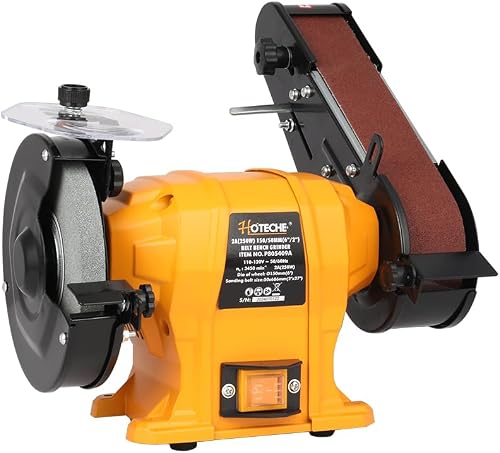 | 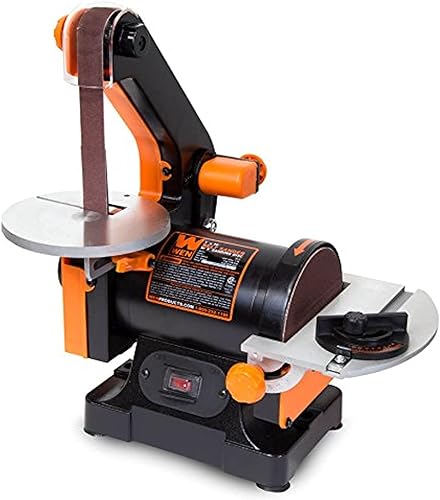 |  |
|---|---|---|---|---|---|---|---|---|---|---|
| Product | VEVOR Belt Grinder Sander | BUCKTOOL Low Speed Sander | BUCKTOOL Belt Disc Combo | Professional Belt Sander | Abrasive Belt Machine | Compact Grinder Sander Combo | SI FANG Mini Sander | Hoteche Bench Grinder Combo | WEN Belt Disc Sander | Mini Belt Sander Sharpener |
| Brand | VEVOR | Bucktool | Bucktool | Goldsand | Futchoy | Greteefor | SI FANG | Hoteche | WEN | Podoy |
| Best for | Best Overall | Best for Knife Sharpening | Best for Finishing | Best for Detailing | — | Best for Benchtop Work | Best for Mini Projects | Best for Dual Tasks | Best for Small Projects | Best for Precision |
| The listing says | 550W motor with 5500 rpm Variable belt speed with VFD | 1790 RPM for 1 x 30 belt 2.3A induction motor | 1/3HP 3.5 Amp motor, 3450 RPM Includes 2-inch x 42-inch sanding belt | 550W motor with 5500 RPM and reverse Includes 1 x 30 inch belts in 100/180/240 grit | DC brushless motor, 30 x 1in belt Steel body with adjustable worktable | 6-inch wheel and 2 x 27 inch belt 2.5A motor with 3600 RPM | 4000–8000 RPM 7-speed adjustment Includes grinding and cloth wheels | 6-inch wheel and 2 x 27 inch belt 250W motor with 2800 RPM | 1 x 30 inch belt and 5-inch disc 2.3A motor, 3160 FPM belt, 3450 RPM disc | Stainless steel construction Adjustable workbench angle |
| More information | Price on Amazon | Price on Amazon | Price on Amazon | Price on Amazon | Price on Amazon | Price on Amazon | Price on Amazon | Price on Amazon | Price on Amazon | Price on Amazon |
1. VEVOR Belt Grinder Sander
Best for: Professional metalworkers and knife makers.
The VEVOR Belt Grinder Sander uses a 550W motor that reaches 5500 RPM. This power allows for stable tracking and effective material removal on both metal and wood. Its variable-speed control is a major benefit, as it lets you switch from fast grinding to fine polishing without changing machines. Use the VFD drive to slow the belt for delicate finish work, or crank it to the maximum 26m/min for rapid stock removal.
This unit offers both vertical and horizontal usage, which is helpful for various angles. Because it includes a detachable workbench, you can adjust your position for better comfort during long tasks. If you’re grinding small, intricate parts, keep the workbench attached to maintain a consistent angle. For larger pieces that require clearance, remove the bench to utilize the full length of the 1×30 inch belt.
This machine isn’t for people with very limited bench space, as its reinforced steel frame is designed for durability and sturdiness rather than portability.
Pros
- Powerful 550W pure copper motor.
- Variable-speed control for versatility.
- Supports both vertical and horizontal use.
Cons
- Requires significant dedicated workbench space.
- Motor speed may be overkill for light tasks.
2. BUCKTOOL 1×30″ Low Speed Belt Sander
Best for: Knife sharpening and precision edge work.
The BUCKTOOL Low Speed Sander is built specifically for controlled material removal. By running at 1790 RPM, it helps prevent the heat buildup that can ruin the temper of a knife blade. The 2.3A induction motor is designed for low-speed sanding and grinding.
The inclusion of an adjustable angle guide, from 10° to 45°, makes it simple to maintain the correct bevel on your blades. It also features a quick-release belt mechanism for fast changes.
If you’re performing heavy-duty stock removal, choose a different tool. This sander is designed for finishing and sharpening rather than aggressive shaping. Pushing the machine too hard during heavy grinding will stall the motor and compromise your finish.
The removable safety key is a critical feature to engage when you aren’t actively sharpening. You should rely on the tracking adjustment knob to keep the 1 x 30 inch belt centered, as failure to do so will cause the belt to fray against the frame.
Pros
- Low speed prevents overheating blades.
- Adjustable precision angle guide included.
- Quick-release belt change mechanism.
Cons
- Not designed for heavy stock removal.
- Limited to light-duty precision tasks.
3. BUCKTOOL 2×42″ Belt Sander 6″ Bench Grinder Combo
Best for: Multi-purpose workshop finishing.
The BUCKTOOL Belt Disc Combo is a heavy-duty unit that features a 3.5A induction motor. It includes a 2-inch by 42-inch belt and a 6-inch grinding wheel, giving you two distinct ways to work on your materials. The belt housing can tilt from 0 to 90 degrees, allowing you to move between horizontal and vertical positions easily.
This combo is highly efficient for general sanding and finishing, especially since it includes two separate workbenches for different materials. Use the cast iron work table for sharpening metal, and switch to the cast aluminum table for wood projects. The sturdy cast iron base with rubber feet prevents vibrations that can ruin a finish.
If you need to change belts often, the quick-release tension and tracking mechanism saves significant time. However, don’t mistake this for a portable tool. Its heavy-duty construction is designed for a permanent spot on your workbench. If you lack a dedicated station, the weight may become a liability rather than a benefit.
Pros
- Dual-function belt and disc system.
- Tilting belt housing for versatility.
- Separate workbenches provide better support.
Cons
- Heavy footprint requires permanent mounting.
- Not ideal for small portable spaces.
4. Professional Belt Sander
Best for: Precision detailing and finishing.
The Professional Belt Sander by GOLDSAND features a 550W motor capable of 5500 RPM. Its VFD variable frequency drive allows for stepless speed regulation, letting you switch between high-speed grinding and low-speed fine sanding.
The machine supports both horizontal and vertical orientations. Use the horizontal mode for flat surface work and the vertical position for contouring or sharpening. When switching between modes, ensure the belt tracking remains stable to avoid edge deviation. A mistake many beginners make is applying too much pressure during fine sanding, which can stall the belt; let the 100, 180, or 240 grit zirconia corundum belts do the work.
The reinforced steel frame provides the necessary rigidity for deburring metal, plastic, or wood. This tool is built for those who require professional-grade control over their finish, rather than those seeking a basic, single-speed device.
Pros
- Includes a reverse function.
- Stepless variable-speed control.
- Steel frame reduces vibration.
Cons
- Stepless control requires a learning curve.
- Not a basic, simple-to-operate tool.
5. Abrasive Belt Machine
Best for: Compact, high-torque household tasks.
The Futchoy Abrasive Belt Machine utilizes a DC brushless motor to deliver high torque while keeping noise levels low. This design is ideal for small workshops where you need to avoid the disruptive hum of standard bench grinders. A digital display allows you to monitor your speed settings precisely, ensuring you maintain the optimal 30M/S line speed for your specific material.
The body and wheels consist of high-quality steel, providing a stable, wear-resistant frame. You can adjust the fixed-angle worktable to any position, which simplifies sharpening and cutting tasks. If you need to switch between vertical and horizontal orientations, the body rotates 90 degrees to accommodate your workspace. It also supports forward and reverse rotation for versatile grinding.
This machine isn’t for projects requiring wide surface sanding. Because the belt width is limited to 1 inch, attempting to sand large boards will result in uneven finishes and wasted time. Use this tool specifically for focused metalwork or small-scale sharpening where precision matters more than surface coverage.
Pros
- Quiet DC brushless motor.
- High torque with digital display.
- Compact steel construction is durable.
Cons
- Small 1-inch belt width.
- Not suitable for wide surface sanding.
6. Compact Grinder Sander Combo
Best for: Everyday DIY projects and small workshops.
The Greteefor Compact Grinder Sander Combo integrates a 6-inch grinding wheel and a 2-inch by 27-inch sanding belt into one footprint. Its 2.5A induction motor delivers a steady 3600 RPM, providing the necessary speed for routine material removal and edge shaping.
Use the 60-grit grinding wheel for general sharpening and initial material removal. When you need to smooth or finish surfaces, switch to the 80-grit sanding belt. If you’re working on small metal parts or woodworking projects, use the removable belt cover to inspect and adjust the belt tension regularly.
The machine includes adjustable eye shields and an LED work light to improve visibility during blade sharpening. Mount this unit directly to your workbench to save space in a crowded garage.
If you’re performing light-duty hobby tasks, this tool is ideal. However, avoid using this machine for high-volume production or heavy-duty grinding.
Pros
- Integrated LED work light.
- Compact benchtop design.
- Includes both wheel and belt.
Cons
- Limited to light-duty hobby tasks.
- Not for professional-grade production.
7. SI FANG Mini Electric Belt Sander Knife-Sharpener Small Bench Grinder
Best for: Small DIY projects and knife making.
The SI FANG Mini Sander is a very compact machine that’s perfect for small DIY tasks. It features a 7-speed adjustment range, allowing you to control the motor speed between 4,000 and 9,000 RPM. The all-copper motor uses double bearings to ensure smooth operation.
Because it’s so small, you can easily use it for multi-angle sanding on various materials. It comes with a variety of accessories, including a cloth wheel for polishing. This unit isn’t for users who need to sand larger items, as its dimensions are only about 4 inches by 4.7 inches.
Pros
- Extremely compact and portable.
- Wide 7-speed adjustment range.
- Includes multiple useful accessories.
Cons
- Very small surface area.
- Not for large material sanding.
8. Hoteche 6″ Bench Grinder & 2″ x 27″ Belt Sander
Best for: Dual-power sharpening and sanding.
The Hoteche Bench Grinder Combo is a 250W power tool that saves space by combining a 6-inch grinding wheel with a 2-inch by 27-inch belt sander. The aluminum oxide wheel is designed to stay sharp longer, making it useful for routine sharpening of tools and knives.
Use the 2800 RPM motor for steady, controlled tasks like deburring metal or shaping wood. If the motor begins to bog down, you’re applying too much pressure; ease off to let the 250W output do the work. This approach prevents premature belt wear and keeps your edges clean.
The construction uses iron wheel covers and an aluminum base to help keep the machine stable during operation. It’s a solid choice for a home workshop where you need to switch between grinding and sanding. This machine isn’t for those who need high-speed material removal, as the motor is tuned for standard, steady work.
Pros
- Space-saving dual-function design.
- Durable aluminum oxide wheel.
- Sturdy iron and aluminum construction.
Cons
- Lower power for heavy removal.
- Not for high-speed industrial use.
9. WEN Benchtop Belt and Disc Sander with 1 x 30
Best for: Small-scale hobbyist projects.
The WEN 6515T provides a 2.3A motor that powers both a 1-by-30 inch belt and a 5-inch disc. This combination excels when you must switch between belt sanding and disc sanding on a single project. The heavy-duty base anchors the unit to prevent walking or wobbling across your bench during operation.
Always connect a vacuum to both separate dust ports to maintain maximum efficiency. If you see dust accumulating on the table, your suction is likely insufficient for the 3160 FPM belt speed. Use the included miter gauge to ensure consistent angles for edge finishing.
This machine isn’t for heavy metal fabrication. It’s designed specifically for woodworking and small finishing tasks. If you’re removing large amounts of material from hardwoods, take light passes to avoid stalling the motor.
Pros
- Combined belt and disc design.
- Includes dual dust ports for debris.
- Sturdy base prevents unit movement.
- Comes with 80-grit disc and 100-grit belt.
Cons
- Not for heavy metal fabrication.
- Limited to light woodworking tasks.
- Requires external vacuum for dust.
10. Mini Belt Sander Sharpener
Best for: Users needing precision variable speed.
The Podoy Mini Belt Sander features a spring-loaded wheel that automatically maintains belt tension, preventing the slippage common in manual tensioning systems. Its 110V motor includes 7-speed control, which allows you to dial in the exact surface speed required for the material at hand. Use lower speeds for plastics to prevent melting, and higher speeds for stainless steel to ensure a clean finish.
The workbench angle adjusts freely, while the slave wheel includes a sliding slot to keep the belt centered without popping. If you require maximum stability, remove the anti-seismic footpads and screw the base directly into your workbench or a wooden block. This eliminates vibration during delicate sharpening tasks.
The included 330mm x 15mm abrasive belts are designed for fine finishing rather than bulk material removal. If the belt drifts, use the eccentric adjustment wheel to correct its verticality. Relying on the spring structure alone is a mistake; manually checking the alignment ensures the belt tracks true, saving you from premature edge wear.
Pros
- Adjustable workbench angle.
- Automatic belt tightness adjustment.
- Durable stainless steel construction.
Cons
- Small size limits material size.
- Not for heavy-duty material removal.
How to Choose in Sixty Seconds
Which motor type is better for my needs?
For most home workshops, induction motors are the standard choice because they offer consistent torque and are built for durability under load. If you’re doing light-duty hobby work or precision knife sharpening, a DC brushless motor is often superior because it runs much quieter and allows for precise speed control.
Induction motors, like those found in the BUCKTOOL Belt Disc Combo, are suitable if you plan on doing sanding or grinding where the machine might bog down. Always check the motor specs in the listing to ensure it matches the intensity of your planned projects. If you see an amperage rating like 3.5A, expect more torque for continuous work compared to 2.3A models.
Does the belt size actually matter for my projects?
Yes, the width of the belt determines what you can realistically finish. A narrow belt, such as those on the VEVOR Belt Grinder Sander, is excellent for detail work, knife sharpening, and tight corners. If you’re working on larger wooden boards or need to remove material quickly, a 2-inch or wider belt is necessary to avoid uneven surface finishes.
Before you buy, consider the physical dimensions of the parts you usually work on. If you only ever sharpen knives, slim models are sufficient, but for general woodworking, wider belts provide much better results. If you choose a slim model, ensure it offers vertical and horizontal support to maximize the limited contact area.
What should I confirm before I order?
Always confirm the mounting requirements and the available space on your workbench. Many combo units are quite heavy and need a permanent, stable surface to operate without vibration. You should also check if the unit comes with a dust port, as sanding creates a significant amount of debris that can affect your health and workshop cleanliness.
Confirming these small details prevents you from having to buy additional mounting hardware or dust collection adapters later. If your workspace is small, look for units with a removable workbench or a compact footprint, such as the SI FANG Mini Sander, which measures only 4 inches by 4.7 inches.
The VEVOR Belt Grinder Sander stands out as the best overall choice due to its balance of power and variable speed control, making it a versatile tool for almost any home shop. For those focused primarily on knife maintenance, the BUCKTOOL Low Speed Sander remains the top recommendation for its specialized speed and angle guides. Other options, like the WEN Belt Disc Sander, are excellent alternatives for hobbyists who need a compact, multi-functional machine. Once you have selected the model that fits your space and typical project size, ensure you have a stable, flat surface ready for mounting to get the most consistent results from your new equipment.
Frequently Asked Questions
What does a belt grinder need to work properly?
A belt grinder requires a stable, flat mounting surface to prevent vibration. You must also ensure you have a compatible power source and a supply of replacement sanding belts in the correct grit sizes. Note that some models benefit significantly from being connected to a vacuum system.
What does owning one ask of the buyer afterwards?
Regular maintenance is required to keep the tracking and tension mechanisms functioning correctly. You must periodically clean dust from the motor housing and belt wheels to prevent buildup. Always inspect sanding belts for wear, as dull belts force the machine to work harder.
What goes wrong first on these machines?
The most common issue on belt grinders is the tracking mechanism losing its alignment, which causes the belt to wander off the wheels during operation. This is often caused by debris buildup inside the tracking housing or improper tensioning of the belt. Regularly clearing dust from the tracking area and ensuring the belt is properly centered before you turn the machine on will help you avoid these mechanical headaches.
Is the simplest one on the list enough?
A compact model like the SI FANG Mini Sander provides essential functions for basic sharpening and small-scale sanding. These units occupy a small footprint, making them ideal for occasional tasks. However, these models may lack the belt width and motor torque required for larger pieces of metal or wood.
Conclusion
Once you’ve picked your machine, don’t forget to stock up on a few extra sanding belts in different grits. You’ll find that having a variety on hand makes every project go much smoother. It’s time to head out to your workshop and start shaping your very first piece of metal.

Hi, this is Cynthia A. Rose. Welcome to my Grinder related blog. Usually, I am busy with my kitchen and cooking all day. My main desire is to create a new recipe every day. But I have to use new tools every day to create new recipes. In this blog, I will share you how to use kitchen tools properly. I will not just share cooking related equipment, I will try to review all kinds of grinders like angle grinder among you. I hope my 12 years of experience will come in handy. Thanks!